
Transcribed from the 1909 Arthur L. Humphreys edition by DavidPrice,best puppet theaters for 2 year olds under 30 dollars email [email protected]
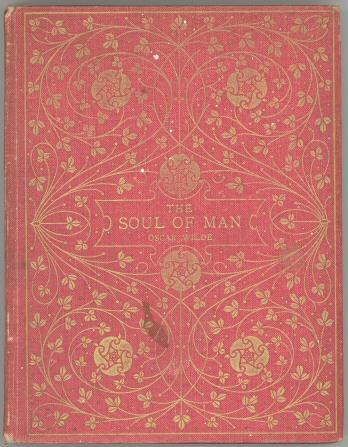
THE
SOUL OF MAN
LONDON
ARTHUR L. HUMPREYS
1900
Second Impression
p. 1THE SOULOF MAN
The chief advantage that wouldresult from the establishment of Socialism is, undoubtedly, thefact that Socialism would relieve us from that sordid necessityof living for others which, in the present condition of things,presses so hardly upon almost everybody. In fact, scarcelyanyone at all escapes.
Now and then, in the course of the century, a great man ofscience, like Darwin; a great poet, like Keats; a fine criticalspirit, like M. Renan; a supreme artist, like Flaubert, has beenable to isolate himself, to keep himself out of reach of theclamorous claims of others, to stand ‘under the shelter ofthe wall,’ as Plato puts it, p. 2and so to realise the perfection ofwhat was in him, to his own incomparable gain, and to theincomparable and lasting gain of the whole world. These,however, are exceptions. The majority of people spoil theirlives by an unhealthy and exaggerated altruism—are forced,indeed, so to spoil them. They find themselves surroundedby hideous poverty, by hideous ugliness, by hideousstarvation. It is inevitable that they should be stronglymoved by all this. The emotions of man are stirred morequickly than man’s intelligence; and, as I pointed out sometime ago in an article on the function of criticism, it is muchmore easy to have sympathy with suffering than it is to havesympathy with thought. Accordingly, with admirable, thoughmisdirected intentions, they very seriously and verysentimentally set themselves to the task of remedying the evilsthat they see. But their remedies do not p. 3cure thedisease: they merely prolong it. Indeed, their remedies arepart of the disease.
They try to solve the problem of poverty, for instance, bykeeping the poor alive; or, in the case of a very advancedschool, by amusing the poor.
But this is not a solution: it is an aggravation of thedifficulty. The proper aim is to try and reconstructsociety on such a basis that poverty will be impossible. And the altruistic virtues have really prevented the carrying outof this aim. Just as the worst slave-owners were those whowere kind to their slaves, and so prevented the horror of thesystem being realised by those who suffered from it, andunderstood by those who contemplated it, so, in the present stateof things in England, the people who do most harm are the peoplewho try to do most good; and at last we have had the spectacle ofmen who have really studied the problem p. 4and know the life—educated menwho live in the East End—coming forward and imploring thecommunity to restrain its altruistic impulses of charity,benevolence, and the like. They do so on the ground thatsuch charity degrades and demoralises. They are perfectlyright. Charity creates a multitude of sins.
There is also this to be said. It is immoral to useprivate property in order to alleviate the horrible evils thatresult from the institution of private property. It is bothimmoral and unfair.
Under Socialism all this will, of course, be altered. There will be no people living in fetid dens and fetid rags, andbringing up unhealthy, hunger-pinched children in the midst ofimpossible and absolutely repulsive surroundings. Thesecurity of society will not depend, as it does now, on the stateof the weather. If a frost comes we shall not have ahundred p.5thousand men out of work, tramping about the streets in astate of disgusting misery, or whining to their neighbours foralms, or crowding round the doors of loathsome shelters to tryand secure a hunch of bread and a night’s uncleanlodging. Each member of the society will share in thegeneral prosperity and happiness of the society, and if a frostcomes no one will practically be anything the worse.
Upon the other hand, Socialism itself will be of value simplybecause it will lead to Individualism.
Socialism, Communism, or whatever one chooses to call it, byconverting private property into public wealth, and substitutingco-operation for competition, will restore society to its propercondition of a thoroughly healthy organism, and insure thematerial well-being of each member of the community. Itwill, in fact, give Life its proper basis and its proper p.6environment. But for the full development of Lifeto its highest mode of perfection, something more isneeded. What is needed is Individualism. If theSocialism is Authoritarian; if there are Governments armed witheconomic power as they are now with political power; if, in aword, we are to have Industrial Tyrannies, then the last state ofman will be worse than the first. At present, inconsequence of the existence of private property, a great manypeople are enabled to develop a certain very limited amount ofIndividualism. They are either under no necessity to workfor their living, or are enabled to choose the sphere of activitythat is really congenial to them, and gives them pleasure. These are the poets, the philosophers, the men of science, themen of culture—in a word, the real men, the men who haverealised themselves, and in whom all Humanity gains a partial p.7realisation. Upon the other hand, there are a greatmany people who, having no private property of their own, andbeing always on the brink of sheer starvation, are compelled todo the work of beasts of burden, to do work that is quiteuncongenial to them, and to which they are forced by theperemptory, unreasonable, degrading Tyranny of want. Theseare the poor, and amongst them there is no grace of manner, orcharm of speech, or civilisation, or culture, or refinement inpleasures, or joy of life. From their collective forceHumanity gains much in material prosperity. But it is onlythe material result that it gains, and the man who is poor is inhimself absolutely of no importance. He is merely theinfinitesimal atom of a force that, so far from regarding him,crushes him: indeed, prefers him crushed, as in that case he isfar more obedient.
Of course, it might be said that the p. 8Individualism generated underconditions of private property is not always, or even as a rule,of a fine or wonderful type, and that the poor, if they have notculture and charm, have still many virtues. Both thesestatements would be quite true. The possession of privateproperty is very often extremely demoralising, and that is, ofcourse, one of the reasons why Socialism wants to get rid of theinstitution. In fact, property is really a nuisance. Some years ago people went about the country saying that propertyhas duties. They said it so often and so tediously that, atlast, the Church has begun to say it. One hears it now fromevery pulpit. It is perfectly true. Property notmerely has duties, but has so many duties that its possession toany large extent is a bore. It involves endless claims uponone, endless attention to business, endless bother. Ifproperty had simply pleasures, we could stand p. 9it; but itsduties make it unbearable. In the interest of the rich wemust get rid of it. The virtues of the poor may be readilyadmitted, and are much to be regretted. We are often toldthat the poor are grateful for charity. Some of them are,no doubt, but the best amongst the poor are never grateful. They are ungrateful, discontented, disobedient, andrebellious. They are quite right to be so. Charitythey feel to be a ridiculously inadequate mode of partialrestitution, or a sentimental dole, usually accompanied by someimpertinent attempt on the part of the sentimentalist totyrannise over their private lives. Why should they begrateful for the crumbs that fall from the rich man’stable? They should be seated at the board, and arebeginning to know it. As for being discontented, a man whowould not be discontented with such surroundings and such a lowmode of life would be a perfect brute. Disobedience, p. 10in the eyesof anyone who has read history, is man’s originalvirtue. It is through disobedience that progress has beenmade, through disobedience and through rebellion. Sometimesthe poor are praised for being thrifty. But to recommendthrift to the poor is both grotesque and insulting. It islike advising a man who is starving to eat less. For a townor country labourer to practise thrift would be absolutelyimmoral. Man should not be ready to show that he can livelike a badly-fed animal. He should decline to live likethat, and should either steal or go on the rates, which isconsidered by many to be a form of stealing. As forbegging, it is safer to beg than to take, but it is finer to takethan to beg. No: a poor man who is ungrateful, unthrifty,discontented, and rebellious, is probably a real personality, andhas much in him. He is at any rate a healthy protest. As for the virtuous p.11poor, one can pity them, of course, but one cannotpossibly admire them. They have made private terms with theenemy, and sold their birthright for very bad pottage. Theymust also be extraordinarily stupid. I can quite understanda man accepting laws that protect private property, and admit ofits accumulation, as long as he himself is able under thoseconditions to realise some form of beautiful and intellectuallife. But it is almost incredible to me how a man whoselife is marred and made hideous by such laws can possiblyacquiesce in their continuance.
However, the explanation is not really difficult tofind. It is simply this. Misery and poverty are soabsolutely degrading, and exercise such a paralysing effect overthe nature of men, that no class is ever really conscious of itsown suffering. They have to be told of it by other people,and they often entirely disbelieve them. p. 12What is saidby great employers of labour against agitators is unquestionablytrue. Agitators are a set of interfering, meddling people,who come down to some perfectly contented class of the community,and sow the seeds of discontent amongst them. That is thereason why agitators are so absolutely necessary. Withoutthem, in our incomplete state, there would be no advance towardscivilisation. Slavery was put down in America, not inconsequence of any action on the part of the slaves, or even anyexpress desire on their part that they should be free. Itwas put down entirely through the grossly illegal conduct ofcertain agitators in Boston and elsewhere, who were not slavesthemselves, nor owners of slaves, nor had anything to do with thequestion really. It was, undoubtedly, the Abolitionists whoset the torch alight, who began the whole thing. And it iscurious to p.13note that from the slaves themselves they received, notmerely very little assistance, but hardly any sympathy even; andwhen at the close of the war the slaves found themselves free,found themselves indeed so absolutely free that they were free tostarve, many of them bitterly regretted the new state ofthings. To the thinker, the most tragic fact in the wholeof the French Revolution is not that Marie Antoinette was killedfor being a queen, but that the starved peasant of theVendée voluntarily went out to die for the hideous causeof feudalism.
It is clear, then, that no Authoritarian Socialism willdo. For while under the present system a very large numberof people can lead lives of a certain amount of freedom andexpression and happiness, under an industrial-barrack system, ora system of economic tyranny, nobody would be able to have anysuch freedom p.14at all. It is to be regretted that a portion ofour community should be practically in slavery, but to propose tosolve the problem by enslaving the entire community ischildish. Every man must be left quite free to choose hisown work. No form of compulsion must be exercised overhim. If there is, his work will not be good for him, willnot be good in itself, and will not be good for others. Andby work I simply mean activity of any kind.
I hardly think that any Socialist, nowadays, would seriouslypropose that an inspector should call every morning at each houseto see that each citizen rose up and did manual labour for eighthours. Humanity has got beyond that stage, and reservessuch a form of life for the people whom, in a very arbitrarymanner, it chooses to call criminals. But I confess thatmany of the socialistic views that I have come across p. 15seem to me tobe tainted with ideas of authority, if not of actualcompulsion. Of course, authority and compulsion are out ofthe question. All association must be quitevoluntary. It is only in voluntary associations that man isfine.
But it may be asked how Individualism, which is now more orless dependent on the existence of private property for itsdevelopment, will benefit by the abolition of such privateproperty. The answer is very simple. It is true that,under existing conditions, a few men who have had private meansof their own, such as Byron, Shelley, Browning, Victor Hugo,Baudelaire, and others, have been able to realise theirpersonality more or less completely. Not one of these menever did a single day’s work for hire. They wererelieved from poverty. They had an immense advantage. The question is whether it would be for the good of Individualismp. 16that suchan advantage should be taken away. Let us suppose that itis taken away. What happens then to Individualism? How will it benefit?
It will benefit in this way. Under the new conditionsIndividualism will be far freer, far finer, and far moreintensified than it is now. I am not talking of the greatimaginatively-realised Individualism of such poets as I havementioned, but of the great actual Individualism latent andpotential in mankind generally. For the recognition ofprivate property has really harmed Individualism, and obscuredit, by confusing a man with what he possesses. It has ledIndividualism entirely astray. It has made gain not growthits aim. So that man thought that the important thing wasto have, and did not know that the important thing is tobe. The true perfection of man lies, not in what man has,but in what man is. p. 17Private property has crushed trueIndividualism, and set up an Individualism that is false. It has debarred one part of the community from being individualby starving them. It has debarred the other part of thecommunity from being individual by putting them on the wrongroad, and encumbering them. Indeed, so completely hasman’s personality been absorbed by his possessions that theEnglish law has always treated offences against a man’sproperty with far more severity than offences against his person,and property is still the test of complete citizenship. Theindustry necessary for the making money is also verydemoralising. In a community like ours, where propertyconfers immense distinction, social position, honour, respect,titles, and other pleasant things of the kind, man, beingnaturally ambitious, makes it his aim to accumulate thisproperty, and goes on wearily and tediously p. 18accumulatingit long after he has got far more than he wants, or can use, orenjoy, or perhaps even know of. Man will kill himself byoverwork in order to secure property, and really, considering theenormous advantages that property brings, one is hardlysurprised. One’s regret is that society should beconstructed on such a basis that man has been forced into agroove in which he cannot freely develop what is wonderful, andfascinating, and delightful in him—in which, in fact, hemisses the true pleasure and joy of living. He is also,under existing conditions, very insecure. An enormouslywealthy merchant may be—often is—at every moment ofhis life at the mercy of things that are not under hiscontrol. If the wind blows an extra point or so, or theweather suddenly changes, or some trivial thing happens, his shipmay go down, his speculations may go wrong, and he finds himselfa poor p.19man, with his social position quite gone. Now,nothing should be able to harm a man except himself. Nothing should be able to rob a man at all. What a manreally has, is what is in him. What is outside of himshould be a matter of no importance.
With the abolition of private property, then, we shall havetrue, beautiful, healthy Individualism. Nobody will wastehis life in accumulating things, and the symbols forthings. One will live. To live is the rarest thing inthe world. Most people exist, that is all.
It is a question whether we have ever seen the full expressionof a personality, except on the imaginative plane of art. In action, we never have. Cæsar, says Mommsen, wasthe complete and perfect man. But how tragically insecurewas Cæsar! Wherever there is a man who exercisesauthority, there is a man who resists authority. Cæsar was very perfect, p. 20but his perfection travelled by toodangerous a road. Marcus Aurelius was the perfect man, saysRenan. Yes; the great emperor was a perfect man. Buthow intolerable were the endless claims upon him! Hestaggered under the burden of the empire. He was conscioushow inadequate one man was to bear the weight of that Titan andtoo vast orb. What I mean by a perfect man is one whodevelops under perfect conditions; one who is not wounded, orworried or maimed, or in danger. Most personalities havebeen obliged to be rebels. Half their strength has beenwasted in friction. Byron’s personality, forinstance, was terribly wasted in its battle with the stupidity,and hypocrisy, and Philistinism of the English. Suchbattles do not always intensify strength: they often exaggerateweakness. Byron was never able to give us what he mighthave given us. Shelley escaped better. Like Byron, hegot out of p.21England as soon as possible. But he was not sowell known. If the English had had any idea of what a greatpoet he really was, they would have fallen on him with tooth andnail, and made his life as unbearable to him as they possiblycould. But he was not a remarkable figure in society, andconsequently he escaped, to a certain degree. Still, evenin Shelley the note of rebellion is sometimes too strong. The note of the perfect personality is not rebellion, butpeace.
It will be a marvellous thing—the true personality ofman—when we see it. It will grow naturally andsimply, flowerlike, or as a tree grows. It will not be atdiscord. It will never argue or dispute. It will notprove things. It will know everything. And yet itwill not busy itself about knowledge. It will havewisdom. Its value will not be measured by materialthings. It will have nothing. And yet it will haveeverything, and whatever p. 22one takes from it, it will stillhave, so rich will it be. It will not be always meddlingwith others, or asking them to be like itself. It will lovethem because they will be different. And yet while it willnot meddle with others, it will help all, as a beautiful thinghelps us, by being what it is. The personality of man willbe very wonderful. It will be as wonderful as thepersonality of a child.
In its development it will be assisted by Christianity, if mendesire that; but if men do not desire that, it will develop nonethe less surely. For it will not worry itself about thepast, nor care whether things happened or did not happen. Nor will it admit any laws but its own laws; nor any authoritybut its own authority. Yet it will love those who sought tointensify it, and speak often of them. And of these Christwas one.
p.23‘Know thyself’ was written over the portalof the antique world. Over the portal of the new world,‘Be thyself’ shall be written. And the messageof Christ to man was simply ‘Be thyself.’ Thatis the secret of Christ.
When Jesus talks about the poor he simply means personalities,just as when he talks about the rich he simply means people whohave not developed their personalities. Jesus moved in acommunity that allowed the accumulation of private property justas ours does, and the gospel that he preached was not that insuch a community it is an advantage for a man to live on scanty,unwholesome food, to wear ragged, unwholesome clothes, to sleepin horrid, unwholesome dwellings, and a disadvantage for a man tolive under healthy, pleasant, and decent conditions. Such aview would have been wrong there and then, and would, of course,be still p.24more wrong now and in England; for as man movesnorthward the material necessities of life become of more vitalimportance, and our society is infinitely more complex, anddisplays far greater extremes of luxury and pauperism than anysociety of the antique world. What Jesus meant, wasthis. He said to man, ‘You have a wonderfulpersonality. Develop it. Be yourself. Don’t imagine that your perfection lies in accumulating orpossessing external things. Your affection is inside ofyou. If only you could realise that, you would not want tobe rich. Ordinary riches can be stolen from a man. Real riches cannot. In the treasury-house of your soul,there are infinitely precious things, that may not be taken fromyou. And so, try to so shape your life that external thingswill not harm you. And try also to get rid of personalproperty. It involves sordid preoccupation, endlessindustry, continual wrong. Personal p. 25propertyhinders Individualism at every step.’ It is to benoted that Jesus never says that impoverished people arenecessarily good, or wealthy people necessarily bad. Thatwould not have been true. Wealthy people are, as a class,better than impoverished people, more moral, more intellectual,more well-behaved. There is only one class in the communitythat thinks more about money than the rich, and that is thepoor. The poor can think of nothing else. That is themisery of being poor. What Jesus does say is that manreaches his perfection, not through what he has, not even throughwhat he does, but entirely through what he is. And so thewealthy young man who comes to Jesus is represented as athoroughly good citizen, who has broken none of the laws of hisstate, none of the commandments of his religion. He isquite respectable, in the ordinary sense of that extraordinaryword. Jesus says p. 26to him, ‘You should give upprivate property. It hinders you from realising yourperfection. It is a drag upon you. It is aburden. Your personality does not need it. It iswithin you, and not outside of you, that you will find what youreally are, and what you really want.’ To his ownfriends he says the same thing. He tells them to bethemselves, and not to be always worrying about otherthings. What do other things matter? Man is completein himself. When they go into the world, the world willdisagree with them. That is inevitable. The worldhates Individualism. But that is not to trouble them. They are to be calm and self-centred. If a man takes theircloak, they are to give him their coat, just to show thatmaterial things are of no importance. If people abuse them,they are not to answer back. What does it signify? The things people say of a man do not alter a man. He iswhat he is. p.27Public opinion is of no value whatsoever. Even ifpeople employ actual violence, they are not to be violent inturn. That would be to fall to the same low level. After all, even in prison, a man can be quite free. Hissoul can be free. His personality can be untroubled. He can be at peace. And, above all things, they are not tointerfere with other people or judge them in any way. Personality is a very mysterious thing. A man cannot alwaysbe estimated by what he does. He may keep the law, and yetbe worthless. He may break the law, and yet be fine. He may be bad, without ever doing anything bad. He maycommit a sin against society, and yet realise through that sinhis true perfection.
There was a woman who was taken in adultery. We are nottold the history of her love, but that love must have been verygreat; for Jesus said that her sins were forgiven her, p. 28not becauseshe repented, but because her love was so intense andwonderful. Later on, a short time before his death, as hesat at a feast, the woman came in and poured costly perfumes onhis hair. His friends tried to interfere with her, and saidthat it was an extravagance, and that the money that the perfumecost should have been expended on charitable relief of people inwant, or something of that kind. Jesus did not accept thatview. He pointed out that the material needs of Man weregreat and very permanent, but that the spiritual needs of Manwere greater still, and that in one divine moment, and byselecting its own mode of expression, a personality might makeitself perfect. The world worships the woman, even now, asa saint.
Yes; there are suggestive things in Individualism. Socialism annihilates family life, for instance. With thep. 29abolitionof private property, marriage in its present form mustdisappear. This is part of the programme. Individualism accepts this and makes it fine. It convertsthe abolition of legal restraint into a form of freedom that willhelp the full development of personality, and make the love ofman and woman more wonderful, more beautiful, and moreennobling. Jesus knew this. He rejected the claims offamily life, although they existed in his day and community in avery marked form. ‘Who is my mother? Who are mybrothers?’ he said, when he was told that they wished tospeak to him. When one of his followers asked leave to goand bury his father, ‘Let the dead bury the dead,’was his terrible answer. He would allow no claim whatsoeverto be made on personality.
And so he who would lead a Christlike life is he who isperfectly and absolutely himself. He may be a p. 30great poet,or a great man of science; or a young student at a University, orone who watches sheep upon a moor; or a maker of dramas, likeShakespeare, or a thinker about God, like Spinoza; or a child whoplays in a garden, or a fisherman who throws his net into thesea. It does not matter what he is, as long as he realisesthe perfection of the soul that is within him. Allimitation in morals and in life is wrong. Through thestreets of Jerusalem at the present day crawls one who is mad andcarries a wooden cross on his shoulders. He is a symbol ofthe lives that are marred by imitation. Father Damien wasChristlike when he went out to live with the lepers, because insuch service he realised fully what was best in him. But hewas not more Christlike than Wagner when he realised his soul inmusic; or than Shelley, when he realised his soul in song. There is no one type for man. p. 31There are as many perfections asthere are imperfect men. And while to the claims of charitya man may yield and yet be free, to the claims of conformity noman may yield and remain free at all.
Individualism, then, is what through Socialism we are toattain to. As a natural result the State must give up allidea of government. It must give it up because, as a wiseman once said many centuries before Christ, there is such a thingas leaving mankind alone; there is no such thing as governingmankind. All modes of government are failures. Despotism is unjust to everybody, including the despot, who wasprobably made for better things. Oligarchies are unjust tothe many, and ochlocracies are unjust to the few. Highhopes were once formed of democracy; but democracy means simplythe bludgeoning of the people by the people for the people. It has been found out. I must say p. 32that it washigh time, for all authority is quite degrading. Itdegrades those who exercise it, and degrades those over whom itis exercised. When it is violently, grossly, and cruellyused, it produces a good effect, by creating, or at any ratebringing out, the spirit of revolt and Individualism that is tokill it. When it is used with a certain amount of kindness,and accompanied by prizes and rewards, it is dreadfullydemoralising. People, in that case, are less conscious ofthe horrible pressure that is being put on them, and so gothrough their lives in a sort of coarse comfort, like pettedanimals, without ever realising that they are probably thinkingother people’s thoughts, living by other people’sstandards, wearing practically what one may call otherpeople’s second-hand clothes, and never being themselvesfor a single moment. ‘He who would be free,’says a fine thinker, ‘must not conform.’ Andauthority, p.33by bribing people to conform, produces a very gross kindof over-fed barbarism amongst us.
With authority, punishment will pass away. This will bea great gain—a gain, in fact, of incalculable value. As one reads history, not in the expurgated editions written forschool-boys and passmen, but in the original authorities of eachtime, one is absolutely sickened, not by the crimes that thewicked have committed, but by the punishments that the good haveinflicted; and a community is infinitely more brutalised by thehabitual employment of punishment, than it is by the occurrenceof crime. It obviously follows that the more punishment isinflicted the more crime is produced, and most modern legislationhas clearly recognised this, and has made it its task to diminishpunishment as far as it thinks it can. Wherever it hasreally diminished it, the results have always been extremely p. 34good. The less punishment, the less crime. When there is nopunishment at all, crime will either cease to exist, or, if itoccurs, will be treated by physicians as a very distressing formof dementia, to be cured by care and kindness. For what arecalled criminals nowadays are not criminals at all. Starvation, and not sin, is the parent of modern crime. That indeed is the reason why our criminals are, as a class, soabsolutely uninteresting from any psychological point ofview. They are not marvellous Macbeths and terribleVautrins. They are merely what ordinary, respectable,commonplace people would be if they had not got enough toeat. When private property is abolished there will be nonecessity for crime, no demand for it; it will cease toexist. Of course, all crimes are not crimes againstproperty, though such are the crimes that the English law,valuing what a man has more than what a p. 35man is,punishes with the harshest and most horrible severity, if weexcept the crime of murder, and regard death as worse than penalservitude, a point on which our criminals, I believe,disagree. But though a crime may not be against property,it may spring from the misery and rage and depression produced byour wrong system of property-holding, and so, when that system isabolished, will disappear. When each member of thecommunity has sufficient for his wants, and is not interferedwith by his neighbour, it will not be an object of any interestto him to interfere with anyone else. Jealousy, which is anextraordinary source of crime in modern life, is an emotionclosely bound up with our conceptions of property, and underSocialism and Individualism will die out. It is remarkablethat in communistic tribes jealousy is entirely unknown.
Now as the State is not to govern, p. 36it may be asked what the State is todo. The State is to be a voluntary association that willorganise labour, and be the manufacturer and distributor ofnecessary commodities. The State is to make what isuseful. The individual is to make what is beautiful. And as I have mentioned the word labour, I cannot help sayingthat a great deal of nonsense is being written and talkednowadays about the dignity of manual labour. There isnothing necessarily dignified about manual labour at all, andmost of it is absolutely degrading. It is mentally andmorally injurious to man to do anything in which he does not findpleasure, and many forms of labour are quite pleasurelessactivities, and should be regarded as such. To sweep aslushy crossing for eight hours, on a day when the east wind isblowing is a disgusting occupation. To sweep it withmental, moral, or physical dignity seems to p. 37me to beimpossible. To sweep it with joy would be appalling. Man is made for something better than disturbing dirt. Allwork of that kind should be done by a machine.
And I have no doubt that it will be so. Up to thepresent, man has been, to a certain extent, the slave ofmachinery, and there is something tragic in the fact that as soonas man had invented a machine to do his work he began tostarve. This, however, is, of course, the result of ourproperty system and our system of competition. One man ownsa machine which does the work of five hundred men. Fivehundred men are, in consequence, thrown out of employment, and,having no work to do, become hungry and take to thieving. The one man secures the produce of the machine and keeps it, andhas five hundred times as much as he should have, and probably,which is of much more importance, a great p. 38deal morethan he really wants. Were that machine the property ofall, every one would benefit by it. It would be an immenseadvantage to the community. All unintellectual labour, allmonotonous, dull labour, all labour that deals with dreadfulthings, and involves unpleasant conditions, must be done bymachinery. Machinery must work for us in coal mines, and doall sanitary services, and be the stoker of steamers, and cleanthe streets, and run messages on wet days, and do anything thatis tedious or distressing. At present machinery competesagainst man. Under proper conditions machinery will serveman. There is no doubt at all that this is the future ofmachinery, and just as trees grow while the country gentleman isasleep, so while Humanity will be amusing itself, or enjoyingcultivated leisure—which, and not labour, is the aim ofman—or making beautiful things, or reading beautiful p. 39things, orsimply contemplating the world with admiration and delight,machinery will be doing all the necessary and unpleasantwork. The fact is, that civilisation requires slaves. The Greeks were quite right there. Unless there are slavesto do the ugly, horrible, uninteresting work, culture andcontemplation become almost impossible. Human slavery iswrong, insecure, and demoralising. On mechanical slavery,on the slavery of the machine, the future of the worlddepends. And when scientific men are no longer called uponto go down to a depressing East End and distribute bad cocoa andworse blankets to starving people, they will have delightfulleisure in which to devise wonderful and marvellous things fortheir own joy and the joy of everyone else. There will begreat storages of force for every city, and for every house ifrequired, and this force man will convert into heat, p. 40light, ormotion, according to his needs. Is this Utopian? Amap of the world that does not include Utopia is not worth evenglancing at, for it leaves out the one country at which Humanityis always landing. And when Humanity lands there, it looksout, and, seeing a better country, sets sail. Progress isthe realisation of Utopias.
Now, I have said that the community by means of organisationof machinery will supply the useful things, and that thebeautiful things will be made by the individual. This isnot merely necessary, but it is the only possible way by which wecan get either the one or the other. An individual who hasto make things for the use of others, and with reference to theirwants and their wishes, does not work with interest, andconsequently cannot put into his work what is best in him. Upon the other hand, whenever a community or a p. 41powerfulsection of a community, or a government of any kind, attempts todictate to the artist what he is to do, Art either entirelyvanishes, or becomes stereotyped, or degenerates into a low andignoble form of craft. A work of art is the unique resultof a unique temperament. Its beauty comes from the factthat the author is what he is. It has nothing to do withthe fact that other people want what they want. Indeed, themoment that an artist takes notice of what other people want, andtries to supply the demand, he ceases to be an artist, andbecomes a dull or an amusing craftsman, an honest or a dishonesttradesman. He has no further claim to be considered as anartist. Art is the most intense mode of Individualism thatthe world has known. I am inclined to say that it is theonly real mode of Individualism that the world has known. Crime, which, under certain conditions, may seem p. 42to havecreated Individualism, must take cognisance of other people andinterfere with them. It belongs to the sphere ofaction. But alone, without any reference to his neighbours,without any interference, the artist can fashion a beautifulthing; and if he does not do it solely for his own pleasure, heis not an artist at all.
And it is to be noted that it is the fact that Art is thisintense form of Individualism that makes the public try toexercise over it in an authority that is as immoral as it isridiculous, and as corrupting as it is contemptible. It isnot quite their fault. The public has always, and in everyage, been badly brought up. They are continually asking Artto be popular, to please their want of taste, to flatter theirabsurd vanity, to tell them what they have been told before, toshow them what they ought to be tired of seeing, to amuse themwhen they feel heavy after eating too much, and to distract p. 43theirthoughts when they are wearied of their own stupidity. NowArt should never try to be popular. The public should tryto make itself artistic. There is a very widedifference. If a man of science were told that the resultsof his experiments, and the conclusions that he arrived at,should be of such a character that they would not upset thereceived popular notions on the subject, or disturb popularprejudice, or hurt the sensibilities of people who knew nothingabout science; if a philosopher were told that he had a perfectright to speculate in the highest spheres of thought, providedthat he arrived at the same conclusions as were held by those whohad never thought in any sphere at all—well, nowadays theman of science and the philosopher would be considerablyamused. Yet it is really a very few years since bothphilosophy and science were subjected to brutal popular control,to authority in fact—p. 44the authority of either the generalignorance of the community, or the terror and greed for power ofan ecclesiastical or governmental class. Of course, we haveto a very great extent got rid of any attempt on the part of thecommunity, or the Church, or the Government, to interfere withthe individualism of speculative thought, but the attempt tointerfere with the individualism of imaginative art stilllingers. In fact, it does more than linger; it isaggressive, offensive, and brutalising.
In England, the arts that have escaped best are the p. 45arts in whichthe public take no interest. Poetry is an instance of whatI mean. We have been able to have fine poetry in Englandbecause the public do not read it, and consequently do notinfluence it. The public like to insult poets because theyare individual, but once they have insulted them, they leave themalone. In the case of the novel and the drama, arts inwhich the public do take an interest, the result of the exerciseof popular authority has been absolutely ridiculous. Nocountry produces such badly-written fiction, such tedious, commonwork in the novel form, such silly, vulgar plays asEngland. It must necessarily be so. The popularstandard is of such a character that no artist can get toit. It is at once too easy and too difficult to be apopular novelist. It is too easy, because the requirementsof the public as far as plot, style, psychology, treatment oflife, and treatment of literature are concerned are within thereach of the very meanest capacity and the most uncultivatedmind. It is too difficult, because to meet suchrequirements the artist would have to do violence to histemperament, would have to write not for the artistic joy ofwriting, but for the amusement of half-educated people, and sowould have to suppress his individualism, p. 46forget hisculture, annihilate his style, and surrender everything that isvaluable in him. In the case of the drama, things are alittle better: the theatre-going public like the obvious, it istrue, but they do not like the tedious; and burlesque andfarcical comedy, the two most popular forms, are distinct formsof art. Delightful work may be produced under burlesque andfarcical conditions, and in work of this kind the artist inEngland is allowed very great freedom. It is when one comesto the higher forms of the drama that the result of popularcontrol is seen. The one thing that the public dislike isnovelty. Any attempt to extend the subject-matter of art isextremely distasteful to the public; and yet the vitality andprogress of art depend in a large measure on the continualextension of subject-matter. The public dislike noveltybecause they are afraid of it. It represents to them a modeof Individualism, an assertion p. 47on the part of the artist that heselects his own subject, and treats it as he chooses. Thepublic are quite right in their attitude. Art isIndividualism, and Individualism is a disturbing anddisintegrating force. Therein lies its immense value. For what it seeks to disturb is monotony of type, slavery ofcustom, tyranny of habit, and the reduction of man to the levelof a machine. In Art, the public accept what has been,because they cannot alter it, not because they appreciateit. They swallow their classics whole, and never tastethem. They endure them as the inevitable, and as theycannot mar them, they mouth about them. Strangely enough,or not strangely, according to one’s own views, thisacceptance of the classics does a great deal of harm. Theuncritical admiration of the Bible and Shakespeare in England isan instance of what I mean. With regard to the Bible,considerations of ecclesiastical p. 48authority enter into the matter, sothat I need not dwell upon the point.
But in the case of Shakespeare it is quite obvious that thepublic really see neither the beauties nor the defects of hisplays. If they saw the beauties, they would not object tothe development of the drama; and if they saw the defects, theywould not object to the development of the drama either. The fact is, the public make use of the classics of a country asa means of checking the progress of Art. They degrade theclassics into authorities. They use them as bludgeons forpreventing the free expression of Beauty in new forms. Theyare always asking a writer why he does not write like somebodyelse, or a painter why he does not paint like somebody else,quite oblivious of the fact that if either of them did anythingof the kind he would cease to be an artist. A fresh mode ofBeauty is absolutely distasteful to them, and whenever it appearsp. 49they getso angry, and bewildered that they always use two stupidexpressions—one is that the work of art is grosslyunintelligible; the other, that the work of art is grosslyimmoral. What they mean by these words seems to me to bethis. When they say a work is grossly unintelligible, theymean that the artist has said or made a beautiful thing that isnew; when they describe a work as grossly immoral, they mean thatthe artist has said or made a beautiful thing that is true. The former expression has reference to style; the latter tosubject-matter. But they probably use the words veryvaguely, as an ordinary mob will use ready-madepaving-stones. There is not a single real poet orprose-writer of this century, for instance, on whom the Britishpublic have not solemnly conferred diplomas of immorality, andthese diplomas practically take the place, with us, of what inFrance, is the formal recognition of an Academy p. 50of Letters,and fortunately make the establishment of such an institutionquite unnecessary in England. Of course, the public arevery reckless in their use of the word. That they shouldhave called Wordsworth an immoral poet, was only to beexpected. Wordsworth was a poet. But that they shouldhave called Charles Kingsley an immoral novelist isextraordinary. Kingsley’s prose was not of a veryfine quality. Still, there is the word, and they use it asbest they can. An artist is, of course, not disturbed byit. The true artist is a man who believes absolutely inhimself, because he is absolutely himself. But I can fancythat if an artist produced a work of art in England thatimmediately on its appearance was recognised by the public,through their medium, which is the public press, as a work thatwas quite intelligible and highly moral, he would begin toseriously question whether in its creation p. 51he had reallybeen himself at all, and consequently whether the work was notquite unworthy of him, and either of a thoroughly second-rateorder, or of no artistic value whatsoever.
Perhaps, however, I have wronged the public in limiting themto such words as ‘immoral,’‘unintelligible,’ ‘exotic,’ and‘unhealthy.’ There is one other word that theyuse. That word is ‘morbid.’ They do notuse it often. The meaning of the word is so simple thatthey are afraid of using it. Still, they use it sometimes,and, now and then, one comes across it in popularnewspapers. It is, of course, a ridiculous word to apply toa work of art. For what is morbidity but a mood of emotionor a mode of thought that one cannot express? The publicare all morbid, because the public can never find expression foranything. The artist is never morbid. He expresseseverything. He stands outside his subject, and through itsp. 52mediumproduces incomparable and artistic effects. To call anartist morbid because he deals with morbidity as hissubject-matter is as silly as if one called Shakespeare madbecause he wrote ‘King Lear.’
On the whole, an artist in England gains something by beingattacked. His individuality is intensified. Hebecomes more completely himself. Of course, the attacks arevery gross, very impertinent, and very contemptible. Butthen no artist expects grace from the vulgar mind, or style fromthe suburban intellect. Vulgarity and stupidity are twovery vivid facts in modern life. One regrets them,naturally. But there they are. They are subjects forstudy, like everything else. And it is only fair to state,with regard to modern journalists, that they always apologise toone in private for what they have written against one inpublic.
Within the last few years two other p. 53adjectives, it may be mentioned, havebeen added to the very limited vocabulary of art-abuse that is atthe disposal of the public. One is the word‘unhealthy,’ the other is the word‘exotic.’ The latter merely expresses the rageof the momentary mushroom against the immortal, entrancing, andexquisitely lovely orchid. It is a tribute, but a tributeof no importance. The word ‘unhealthy,’however, admits of analysis. It is a rather interestingword. In fact, it is so interesting that the people who useit do not know what it means.
What does it mean? What is a healthy, or an unhealthywork of art? All terms that one applies to a work of art,provided that one applies them rationally, have reference toeither its style or its subject, or to both together. Fromthe point of view of style, a healthy work of art is one whosestyle recognises the beauty of the material it employs, be thatmaterial one of words p. 54or of bronze, of colour or of ivory,and uses that beauty as a factor in producing the æstheticeffect. From the point of view of subject, a healthy workof art is one the choice of whose subject is conditioned by thetemperament of the artist, and comes directly out of it. Infine, a healthy work of art is one that has both perfection andpersonality. Of course, form and substance cannot beseparated in a work of art; they are always one. But forpurposes of analysis, and setting the wholeness of æstheticimpression aside for a moment, we can intellectually so separatethem. An unhealthy work of art, on the other hand, is awork whose style is obvious, old-fashioned, and common, and whosesubject is deliberately chosen, not because the artist has anypleasure in it, but because he thinks that the public will payhim for it. In fact, the popular novel that the publiccalls healthy is always a thoroughly unhealthy production; p. 55and what thepublic call an unhealthy novel is always a beautiful and healthywork of art.
I need hardly say that I am not, for a single moment,complaining that the public and the public press misuse thesewords. I do not see how, with their lack of comprehensionof what Art is, they could possibly use them in the propersense. I am merely pointing out the misuse; and as for theorigin of the misuse and the meaning that lies behind it all, theexplanation is very simple. It comes from the barbarousconception of authority. It comes from the naturalinability of a community corrupted by authority to understand orappreciate Individualism. In a word, it comes from thatmonstrous and ignorant thing that is called Public Opinion,which, bad and well-meaning as it is when it tries to controlaction, is infamous and of evil meaning when it tries to controlThought or Art.
p. 56Indeed,there is much more to be said in favour of the physical force ofthe public than there is in favour of the public’sopinion. The former may be fine. The latter must befoolish. It is often said that force is no argument. That, however, entirely depends on what one wants to prove. Many of the most important problems of the last few centuries,such as the continuance of personal government in England, or offeudalism in France, have been solved entirely by means ofphysical force. The very violence of a revolution may makethe public grand and splendid for a moment. It was a fatalday when the public discovered that the pen is mightier than thepaving-stone, and can be made as offensive as the brickbat. They at once sought for the journalist, found him, developed him,and made him their industrious and well-paid servant. It isgreatly to be regretted, for both their sakes. p. 57Behind thebarricade there may be much that is noble and heroic. Butwhat is there behind the leading-article but prejudice,stupidity, cant, and twaddle? And when these four arejoined together they make a terrible force, and constitute thenew authority.
In old days men had the rack. Now they have thepress. That is an improvement certainly. But still itis very bad, and wrong, and demoralising. Somebody—was it Burke?—called journalism the fourthestate. That was true at the time, no doubt. But atthe present moment it really is the only estate. It haseaten up the other three. The Lords Temporal say nothing,the Lords Spiritual have nothing to say, and the House of Commonshas nothing to say and says it. We are dominated byJournalism. In America the President reigns for four years,and Journalism governs for ever and ever. Fortunately p. 58in AmericaJournalism has carried its authority to the grossest and mostbrutal extreme. As a natural consequence it has begun tocreate a spirit of revolt. People are amused by it, ordisgusted by it, according to their temperaments. But it isno longer the real force it was. It is not seriouslytreated. In England, Journalism, not, except in a fewwell-known instances, having been carried to such excesses ofbrutality, is still a great factor, a really remarkablepower. The tyranny that it proposes to exercise overpeople’s private lives seems to me to be quiteextraordinary. The fact is, that the public have aninsatiable curiosity to know everything, except what is worthknowing. Journalism, conscious of this, and havingtradesman-like habits, supplies their demands. In centuriesbefore ours the public nailed the ears of journalists to thepump. That was quite hideous. In this centuryjournalists have nailed their p. 59own ears to the keyhole. Thatis much worse. And what aggravates the mischief is that thejournalists who are most to blame are not the amusing journalistswho write for what are called Society papers. The harm isdone by the serious, thoughtful, earnest journalists, whosolemnly, as they are doing at present, will drag before the eyesof the public some incident in the private life of a greatstatesman, of a man who is a leader of political thought as he isa creator of political force, and invite the public to discussthe incident, to exercise authority in the matter, to give theirviews, and not merely to give their views, but to carry them intoaction, to dictate to the man upon all other points, to dictateto his party, to dictate to his country; in fact, to makethemselves ridiculous, offensive, and harmful. The privatelives of men and women should not be told to the public. The public have nothing to p. 60do with them at all. In Francethey manage these things better. There they do not allowthe details of the trials that take place in the divorce courtsto be published for the amusement or criticism of thepublic. All that the public are allowed to know is that thedivorce has taken place and was granted on petition of one orother or both of the married parties concerned. In France,in fact, they limit the journalist, and allow the artist almostperfect freedom. Here we allow absolute freedom to thejournalist, and entirely limit the artist. English publicopinion, that is to say, tries to constrain and impede and warpthe man who makes things that are beautiful in effect, andcompels the journalist to retail things that are ugly, ordisgusting, or revolting in fact, so that we have the mostserious journalists in the world, and the most indecentnewspapers. It is no exaggeration to talk ofcompulsion. There p. 61are possibly some journalists whotake a real pleasure in publishing horrible things, or who, beingpoor, look to scandals as forming a sort of permanent basis foran income. But there are other journalists, I feel certain,men of education and cultivation, who really dislike publishingthese things, who know that it is wrong to do so, and only do itbecause the unhealthy conditions under which their occupation iscarried on oblige them to supply the public with what the publicwants, and to compete with other journalists in making thatsupply as full and satisfying to the gross popular appetite aspossible. It is a very degrading position for any body ofeducated men to be placed in, and I have no doubt that most ofthem feel it acutely.
However, let us leave what is really a very sordid side of thesubject, and return to the question of popular control in thematter of Art, by which p. 62I mean Public Opinion dictating tothe artist the form which he is to use, the mode in which he isto use it, and the materials with which he is to work. Ihave pointed out that the arts which have escaped best in Englandare the arts in which the public have not been interested. They are, however, interested in the drama, and as a certainadvance has been made in the drama within the last ten or fifteenyears, it is important to point out that this advance is entirelydue to a few individual artists refusing to accept the popularwant of taste as their standard, and refusing to regard Art as amere matter of demand and supply. With his marvellous andvivid personality, with a style that has really a truecolour-element in it, with his extraordinary power, not over meremimicry but over imaginative and intellectual creation, MrIrving, had his sole object been to give the public what theywanted, could have produced p. 63the commonest plays in the commonestmanner, and made as much success and money as a man couldpossibly desire. But his object was not that. Hisobject was to realise his own perfection as an artist, undercertain conditions, and in certain forms of Art. At firsthe appealed to the few: now he has educated the many. Hehas created in the public both taste and temperament. Thepublic appreciate his artistic success immensely. I oftenwonder, however, whether the public understand that that successis entirely due to the fact that he did not accept theirstandard, but realised his own. With their standard theLyceum would have been a sort of second-rate booth, as some ofthe popular theatres in London are at present. Whether theyunderstand it or not the fact however remains, that taste andtemperament have, to a certain extent been created in the public,and that p.64the public is capable of developing thesequalities. The problem then is, why do not the publicbecome more civilised? They have the capacity. Whatstops them?
The thing that stops them, it must be said again, is theirdesire to exercise authority over the artist and over works ofart. To certain theatres, such as the Lyceum and theHaymarket, the public seem to come in a proper mood. Inboth of these theatres there have been individual artists, whohave succeeded in creating in their audiences—and everytheatre in London has its own audience—the temperament towhich Art appeals. And what is that temperament? Itis the temperament of receptivity. That is all.
If a man approaches a work of art with any desire to exerciseauthority over it and the artist, he approaches it in such aspirit that he cannot receive any artistic impression from it atall. The work of art is to dominate p. 65thespectator: the spectator is not to dominate the work ofart. The spectator is to be receptive. He is to bethe violin on which the master is to play. And the morecompletely he can suppress his own silly views, his own foolishprejudices, his own absurd ideas of what Art should be, or shouldnot be, the more likely he is to understand and appreciate thework of art in question. This is, of course, quite obviousin the case of the vulgar theatre-going public of English men andwomen. But it is equally true of what are called educatedpeople. For an educated person’s ideas of Art aredrawn naturally from what Art has been, whereas the new work ofart is beautiful by being what Art has never been; and to measureit by the standard of the past is to measure it by a standard onthe rejection of which its real perfection depends. Atemperament capable of receiving, through an imaginative medium,and under imaginative p. 66conditions, new and beautifulimpressions, is the only temperament that can appreciate a workof art. And true as this is in the case of the appreciationof sculpture and painting, it is still more true of theappreciation of such arts as the drama. For a picture and astatue are not at war with Time. They take no count of itssuccession. In one moment their unity may beapprehended. In the case of literature it isdifferent. Time must be traversed before the unity ofeffect is realised. And so, in the drama, there may occurin the first act of the play something whose real artistic valuemay not be evident to the spectator till the third or fourth actis reached. Is the silly fellow to get angry and call out,and disturb the play, and annoy the artists? No. Thehonest man is to sit quietly, and know the delightful emotions ofwonder, curiosity, and suspense. He is not to go to theplay to lose a vulgar p. 67temper. He is to go to the playto realise an artistic temperament. He is to go to the playto gain an artistic temperament. He is not the arbiter ofthe work of art. He is one who is admitted to contemplatethe work of art, and, if the work be fine, to forget in itscontemplation and the egotism that mars him—the egotism ofhis ignorance, or the egotism of his information. Thispoint about the drama is hardly, I think, sufficientlyrecognised. I can quite understand that were‘Macbeth’ produced for the first time before a modernLondon audience, many of the people present would strongly andvigorously object to the introduction of the witches in the firstact, with their grotesque phrases and their ridiculouswords. But when the play is over one realises that thelaughter of the witches in ‘Macbeth’ is as terribleas the laughter of madness in ‘Lear,’ more terriblethan the laughter of Iago in the tragedy of the p. 68Moor. No spectator of art needs a more perfect mood of receptivity thanthe spectator of a play. The moment he seeks to exerciseauthority he becomes the avowed enemy of Art and ofhimself. Art does not mind. It is he who suffers.
With the novel it is the same thing. Popular authorityand the recognition of popular authority are fatal. Thackeray’s ‘Esmond’ is a beautiful work of artbecause he wrote it to please himself. In his other novels,in ‘Pendennis,’ in ‘Philip,’ in‘Vanity Fair’ even, at times, he is too conscious ofthe public, and spoils his work by appealing directly to thesympathies of the public, or by directly mocking at them. Atrue artist takes no notice whatever of the public. Thepublic are to him non-existent. He has no poppied orhoneyed cakes through which to give the monster sleep orsustenance. He leaves that to the popular novelist. One incomparable novelist we have p. 69now in England, Mr GeorgeMeredith. There are better artists in France, but Francehas no one whose view of life is so large, so varied, soimaginatively true. There are tellers of stories in Russiawho have a more vivid sense of what pain in fiction may be. But to him belongs philosophy in fiction. His people notmerely live, but they live in thought. One can see themfrom myriad points of view. They are suggestive. There is soul in them and around them. They areinterpretative and symbolic. And he who made them, thosewonderful quickly-moving figures, made them for his own pleasure,and has never asked the public what they wanted, has never caredto know what they wanted, has never allowed the public to dictateto him or influence him in any way but has gone on intensifyinghis own personality, and producing his own individual work. At first none came to him. That did not matter. Thenthe few came to p.70him. That did not change him. The many havecome now. He is still the same. He is an incomparablenovelist.
With the decorative arts it is not different. The publicclung with really pathetic tenacity to what I believe were thedirect traditions of the Great Exhibition of internationalvulgarity, traditions that were so appalling that the houses inwhich people lived were only fit for blind people to livein. Beautiful things began to be made, beautiful colourscame from the dyer’s hand, beautiful patterns from theartist’s brain, and the use of beautiful things and theirvalue and importance were set forth. The public were reallyvery indignant. They lost their temper. They saidsilly things. No one minded. No one was a whit theworse. No one accepted the authority of publicopinion. And now it is almost impossible to enter anymodern house without seeing some recognition of good taste, somerecognition of the value of lovely surroundings, p. 71some sign ofappreciation of beauty. In fact, people’s houses are,as a rule, quite charming nowadays. People have been to avery great extent civilised. It is only fair to state,however, that the extraordinary success of the revolution inhouse-decoration and furniture and the like has not really beendue to the majority of the public developing a very fine taste insuch matters. It has been chiefly due to the fact that thecraftsmen of things so appreciated the pleasure of making whatwas beautiful, and woke to such a vivid consciousness of thehideousness and vulgarity of what the public had previouslywanted, that they simply starved the public out. It wouldbe quite impossible at the present moment to furnish a room asrooms were furnished a few years ago, without going foreverything to an auction of second-hand furniture from somethird-rate lodging-house. The things are no longermade. However they p. 72may object to it, people mustnowadays have something charming in their surroundings. Fortunately for them, their assumption of authority in theseart-matters came to entire grief.
It is evident, then, that all authority in such things isbad. People sometimes inquire what form of government ismost suitable for an artist to live under. To this questionthere is only one answer. The form of government that ismost suitable to the artist is no government at all. Authority over him and his art is ridiculous. It has beenstated that under despotisms artists have produced lovelywork. This is not quite so. Artists have visiteddespots, not as subjects to be tyrannised over, but as wanderingwonder-makers, as fascinating vagrant personalities, to beentertained and charmed and suffered to be at peace, and allowedto create. There is this to be said in favour of thedespot, that he, being an individual, p. 73may have culture, while the mob,being a monster, has none. One who is an Emperor and Kingmay stoop down to pick up a brush for a painter, but when thedemocracy stoops down it is merely to throw mud. And yetthe democracy have not so far to stoop as the emperor. Infact, when they want to throw mud they have not to stoop atall. But there is no necessity to separate the monarch fromthe mob; all authority is equally bad.
There are three kinds of despots. There is the despotwho tyrannises over the body. There is the despot whotyrannises over the soul. There is the despot whotyrannises over the soul and body alike. The first iscalled the Prince. The second is called the Pope. Thethird is called the People. The Prince may becultivated. Many Princes have been. Yet in the Princethere is danger. One thinks of Dante at the bitter feast p. 74in Verona, ofTasso in Ferrara’s madman’s cell. It is betterfor the artist not to live with Princes. The Pope may becultivated. Many Popes have been; the bad Popes havebeen. The bad Popes loved Beauty, almost as passionately,nay, with as much passion as the good Popes hated Thought. To the wickedness of the Papacy humanity owes much. Thegoodness of the Papacy owes a terrible debt to humanity. Yet, though the Vatican has kept the rhetoric of its thunders,and lost the rod of its lightning, it is better for the artistnot to live with Popes. It was a Pope who said of Cellinito a conclave of Cardinals that common laws and common authoritywere not made for men such as he; but it was a Pope who thrustCellini into prison, and kept him there till he sickened withrage, and created unreal visions for himself, and saw the gildedsun enter his room, and grew so enamoured of p. 75it that hesought to escape, and crept out from tower to tower, and fallingthrough dizzy air at dawn, maimed himself, and was by avine-dresser covered with vine leaves, and carried in a cart toone who, loving beautiful things, had care of him. There isdanger in Popes. And as for the People, what of them andtheir authority? Perhaps of them and their authority onehas spoken enough. Their authority is a thing blind, deaf,hideous, grotesque, tragic, amusing, serious, and obscene. It is impossible for the artist to live with the People. All despots bribe. The people bribe and brutalise. Who told them to exercise authority? They were made tolive, to listen, and to love. Someone has done them a greatwrong. They have marred themselves by imitation of theirinferiors. They have taken the sceptre of the Prince. How should they use it? They have taken the triple tiara ofthe Pope. How should p. 76they carry its burden? They areas a clown whose heart is broken. They are as a priestwhose soul is not yet born. Let all who love Beauty pitythem. Though they themselves love not Beauty, yet let thempity themselves. Who taught them the trick of tyranny?
There are many other things that one might point out. One might point out how the Renaissance was great, because itsought to solve no social problem, and busied itself not aboutsuch things, but suffered the individual to develop freely,beautifully, and naturally, and so had great and individualartists, and great and individual men. One might point outhow Louis XIV., by creating the modern state, destroyed theindividualism of the artist, and made things monstrous in theirmonotony of repetition, and contemptible in their conformity torule, and destroyed throughout all France all those fine freedomsof expression p.77that had made tradition new in beauty, and new modes onewith antique form. But the past is of no importance. The present is of no importance. It is with the future thatwe have to deal. For the past is what man should not havebeen. The present is what man ought not to be. Thefuture is what artists are.
It will, of course, be said that such a scheme as is set forthhere is quite unpractical, and goes against human nature. This is perfectly true. It is unpractical, and it goesagainst human nature. This is why it is worth carrying out,and that is why one proposes it. For what is a practicalscheme? A practical scheme is either a scheme that isalready in existence, or a scheme that could be carried out underexisting conditions. But it is exactly the existingconditions that one objects to; and any scheme that could acceptthese conditions is wrong and foolish. The conditions willbe p. 78doneaway with, and human nature will change. The only thingthat one really knows about human nature is that itchanges. Change is the one quality we can predicate ofit. The systems that fail are those that rely on thepermanency of human nature, and not on its growth anddevelopment. The error of Louis XIV. was that he thoughthuman nature would always be the same. The result of hiserror was the French Revolution. It was an admirableresult. All the results of the mistakes of governments arequite admirable.
It is to be noted also that Individualism does not come to manwith any sickly cant about duty, which merely means doing whatother people want because they want it; or any hideous cant aboutself-sacrifice, which is merely a survival of savagemutilation. In fact, it does not come to man with anyclaims upon him at all. It comes naturally p. 79andinevitably out of man. It is the point to which alldevelopment tends. It is the differentiation to which allorganisms grow. It is the perfection that is inherent inevery mode of life, and towards which every mode of lifequickens. And so Individualism exercises no compulsion overman. On the contrary, it says to man that he should sufferno compulsion to be exercised over him. It does not try toforce people to be good. It knows that people are good whenthey are let alone. Man will develop Individualism out ofhimself. Man is now so developing Individualism. Toask whether Individualism is practical is like asking whetherEvolution is practical. Evolution is the law of life, andthere is no evolution except towards Individualism. Wherethis tendency is not expressed, it is a case ofartificially-arrested growth, or of disease, or of death.
Individualism will also be unselfish p. 80andunaffected. It has been pointed out that one of the resultsof the extraordinary tyranny of authority is that words areabsolutely distorted from their proper and simple meaning, andare used to express the obverse of their rightsignification. What is true about Art is true aboutLife. A man is called affected, nowadays, if he dresses ashe likes to dress. But in doing that he is acting in aperfectly natural manner. Affectation, in such matters,consists in dressing according to the views of one’sneighbour, whose views, as they are the views of the majority,will probably be extremely stupid. Or a man is calledselfish if he lives in the manner that seems to him most suitablefor the full realisation of his own personality; if, in fact, theprimary aim of his life is self-development. But this isthe way in which everyone should live. Selfishness is notliving as one wishes to live, it is p. 81asking others to live as one wishesto live. And unselfishness is letting other people’slives alone, not interfering with them. Selfishness alwaysaims at creating around it an absolute uniformity of type. Unselfishness recognises infinite variety of type as a delightfulthing, accepts it, acquiesces in it, enjoys it. It is notselfish to think for oneself. A man who does not think forhimself does not think at all. It is grossly selfish torequire of ones neighbour that he should think in the same way,and hold the same opinions. Why should he? If he canthink, he will probably think differently. If he cannotthink, it is monstrous to require thought of any kind fromhim. A red rose is not selfish because it wants to be a redrose. It would be horribly selfish if it wanted all theother flowers in the garden to be both red and roses. UnderIndividualism people will be quite natural and absolutelyunselfish, p.82and will know the meanings of the words, and realisethem in their free, beautiful lives. Nor will men beegotistic as they are now. For the egotist is he who makesclaims upon others, and the Individualist will not desire to dothat. It will not give him pleasure. When man hasrealised Individualism, he will also realise sympathy andexercise it freely and spontaneously. Up to the present manhas hardly cultivated sympathy at all. He has merelysympathy with pain, and sympathy with pain is not the highestform of sympathy. All sympathy is fine, but sympathy withsuffering is the least fine mode. It is tainted withegotism. It is apt to become morbid. There is in it acertain element of terror for our own safety. We becomeafraid that we ourselves might be as the leper or as the blind,and that no man would have care of us. It is curiouslylimiting, too. One should sympathise with p. 83the entiretyof life, not with life’s sores and maladies merely, butwith life’s joy and beauty and energy and health andfreedom. The wider sympathy is, of course, the moredifficult. It requires more unselfishness. Anybodycan sympathise with the sufferings of a friend, but it requires avery fine nature—it requires, in fact, the nature of a trueIndividualist—to sympathise with a friend’ssuccess.
In the modern stress of competition and struggle for place,such sympathy is naturally rare, and is also very much stifled bythe immoral ideal of uniformity of type and conformity to rulewhich is so prevalent everywhere, and is perhaps most obnoxiousin England.
Sympathy with pain there will, of course, always be. Itis one of the first instincts of man. The animals which areindividual, the higher animals, that is to say, share it withus. But it must be remembered that p. 84whilesympathy with joy intensifies the sum of joy in the world,sympathy with pain does not really diminish the amount ofpain. It may make man better able to endure evil, but theevil remains. Sympathy with consumption does not cureconsumption; that is what Science does. And when Socialismhas solved the problem of poverty, and Science solved the problemof disease, the area of the sentimentalists will be lessened, andthe sympathy of man will be large, healthy, andspontaneous. Man will have joy in the contemplation of thejoyous life of others.
For it is through joy that the Individualism of the futurewill develop itself. Christ made no attempt to reconstructsociety, and consequently the Individualism that he preached toman could be realised only through pain or in solitude. Theideals that we owe to Christ are the ideals of the man whoabandons society entirely, or of the man p. 85who resistssociety absolutely. But man is naturally social. Eventhe Thebaid became peopled at last. And though the cenobiterealises his personality, it is often an impoverished personalitythat he so realises. Upon the other hand, the terribletruth that pain is a mode through which man may realise himselfexercises a wonderful fascination over the world. Shallowspeakers and shallow thinkers in pulpits and on platforms oftentalk about the world’s worship of pleasure, and whineagainst it. But it is rarely in the world’s historythat its ideal has been one of joy and beauty. The worshipof pain has far more often dominated the world. Mediævalism, with its saints and martyrs, its love ofself-torture, its wild passion for wounding itself, its gashingwith knives, and its whipping with rods—Mediævalismis real Christianity, and the mediæval Christ is the realChrist. When the Renaissance dawned upon the world, andbrought p.86with it the new ideals of the beauty of life and the joyof living, men could not understand Christ. Even Art showsus that. The painters of the Renaissance drew Christ as alittle boy playing with another boy in a palace or a garden, orlying back in his mother’s arms, smiling at her, or at aflower, or at a bright bird; or as a noble, stately figure movingnobly through the world; or as a wonderful figure rising in asort of ecstasy from death to life. Even when they drew himcrucified they drew him as a beautiful God on whom evil men hadinflicted suffering. But he did not preoccupy themmuch. What delighted them was to paint the men and womenwhom they admired, and to show the loveliness of this lovelyearth. They painted many religious pictures—in fact,they painted far too many, and the monotony of type and motive iswearisome, and was bad for art. It was the result of theauthority of the public in art-matters, and is to bedeplored. But p.87their soul was not in the subject. Raphael was agreat artist when he painted his portrait of the Pope. Whenhe painted his Madonnas and infant Christs, he is not a greatartist at all. Christ had no message for the Renaissance,which was wonderful because it brought an ideal at variance withhis, and to find the presentation of the real Christ we must goto mediæval art. There he is one maimed and marred;one who is not comely to look on, because Beauty is a joy; onewho is not in fair raiment, because that may be a joy also: he isa beggar who has a marvellous soul; he is a leper whose soul isdivine; he needs neither property nor health; he is a Godrealising his perfection through pain.
The evolution of man is slow. The injustice of men isgreat. It was necessary that pain should be put forward asa mode of self-realisation. Even now, in some places in theworld, the message of Christ is necessary. No one who livedp. 88in modernRussia could possibly realise his perfection except bypain. A few Russian artists have realised themselves inArt; in a fiction that is mediæval in character, becauseits dominant note is the realisation of men throughsuffering. But for those who are not artists, and to whomthere is no mode of life but the actual life of fact, pain is theonly door to perfection. A Russian who lives happily underthe present system of government in Russia must either believethat man has no soul, or that, if he has, it is not worthdeveloping. A Nihilist who rejects all authority, becausehe knows authority to be evil, and welcomes all pain, becausethrough that he realises his personality, is a realChristian. To him the Christian ideal is a true thing.
And yet, Christ did not revolt against authority. Heaccepted the imperial authority of the Roman Empire and paidtribute. He endured the ecclesiastical authority of theJewish p.89Church, and would not repel its violence by any violenceof his own. He had, as I said before, no scheme for thereconstruction of society. But the modern world hasschemes. It proposes to do away with poverty and thesuffering that it entails. It desires to get rid of pain,and the suffering that pain entails. It trusts to Socialismand to Science as its methods. What it aims at is anIndividualism expressing itself through joy. ThisIndividualism will be larger, fuller, lovelier than anyIndividualism has ever been. Pain is not the ultimate modeof perfection. It is merely provisional and aprotest. It has reference to wrong, unhealthy, unjustsurroundings. When the wrong, and the disease, and theinjustice are removed, it will have no further place. Itwill have done its work. It was a great work, but it isalmost over. Its sphere lessens every day.
Nor will man miss it. For what man p. 90has soughtfor is, indeed, neither pain nor pleasure, but simply Life. Man has sought to live intensely, fully, perfectly. When hecan do so without exercising restraint on others, or suffering itever, and his activities are all pleasurable to him, he will besaner, healthier, more civilised, more himself. Pleasure isNature’s test, her sign of approval. When man ishappy, he is in harmony with himself and his environment. The new Individualism, for whose service Socialism, whether itwills it or not, is working, will be perfect harmony. Itwill be what the Greeks sought for, but could not, except inThought, realise completely, because they had slaves, and fedthem; it will be what the Renaissance sought for, but could notrealise completely except in Art, because they had slaves, andstarved them. It will be complete, and through it each manwill attain to his perfection. The new Individualism is thenew Hellenism.
p. 91Reprinted from the‘Fortnightly Review,’
by permission of Messrs Chapman and Hall.

 Related articles


 Featured reads

 Hot news
 Follow us
